Most of what gets written about strength training over 60 is written by people who've never coached anyone over 60.
So instead of general advice, here's two years with one member of my gym. She was 64 when she started. She's 66 now, and her scans tell a story I didn't expect to be able to show you this clearly.
What she walked in with
A diagnosis of osteoporosis, and a list of things her body wouldn't do.
- She couldn't squat properly or run
- Significant knee pain, and severe weakness around the joint
- She wore knee sleeves for almost everything
- Back pain
- Pressure in her head during exertion
- Poor balance and poor posture
The simplest movements gave her real problems. Not "this is hard" problems — "my body won't do this" problems.
If that sounds like you, read the next part carefully, because it's the part everyone skips.
We didn't start with the barbell
She was under a barbell from week one. It just wasn't heavy, and that was deliberate.
Ankle mobility. Balance. Core activation — teaching the muscles to switch on at the right time, which sounds trivial and isn't.
We squatted to a box, which did two jobs at once. It capped her depth, because her mobility wouldn't allow a full squat safely. And it gave her a target to control the descent to, while she learned something more important.
That something was intra-abdominal bracing — how to pressurize the trunk to protect the spine under load. I can teach the technique in one session. Her transverse abdominis being strong enough to actually hold it took about six months. Until then, every heavy rep would have been loading a spine that was still unstable.
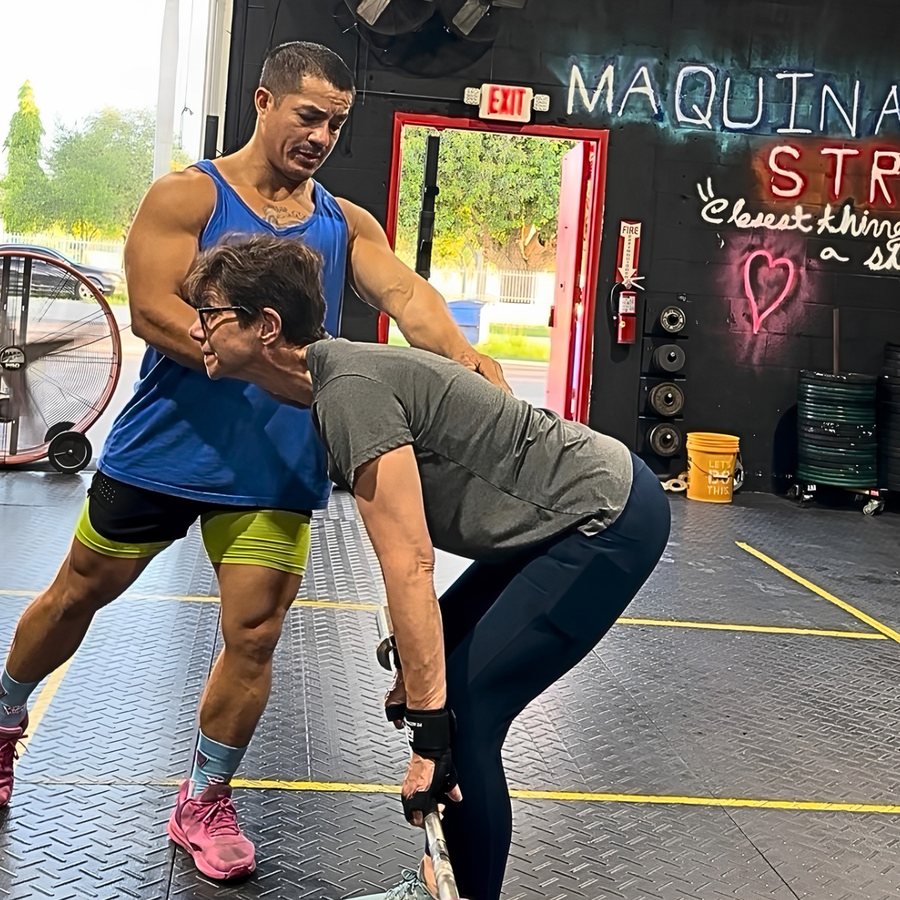
The goal in those early months wasn't to make her strong. It was to make her trainable — to restore enough position and control that loading her hard wouldn't hurt her.
Around the six-month mark she was stable enough. That's when the weight started going up in earnest.
This is where most programs for older adults go wrong in one of two directions.
Either they never progress past this stage — gentle forever, and the person plateaus in a world of resistance bands — or they skip it entirely and load someone who can't yet get into position.
It's a phase, not a destination. You do the restoration work so that the real training becomes possible.
The interruption
She spends part of each year out of state. In October 2025 she came back to Florida with pain in her wrists — and her doctor told her not to train.
So she didn't. For two months she sat out — and nothing improved. The wrist pain stayed, and other things started slipping back.
At the end of December she asked for a second opinion. That doctor did something the first hadn't: he asked to see the actual training protocols. He read them, and told her to go back to training, following that programming.
She came back in December. Within months the wrist pain was gone, and she stopped needing the knee sleeves.
What to take from that, and what not to
The lesson isn't that doctors are wrong about exercise. It's that "weight training" means wildly different things, and a physician being asked to approve an unknown quantity will reasonably be cautious.
The second doctor could make a better call because he could see the specific loads, movements and progressions. That's the difference — not his opinion versus the first one, but having the actual information in front of him.
If you've been told to stop training and it doesn't sit right, bring your programming to the conversation. Not a vague description of going to the gym — the actual plan.
The part I'm proudest of
Her scans showed poor bone density at the radius — the forearm bone, one of her weakest sites.
So we programmed bench press. Deliberately, for that reason. Pressing loads the radius directly, and bone responds to the force transmitted through it. Squats and deadlifts don't do much for a forearm.
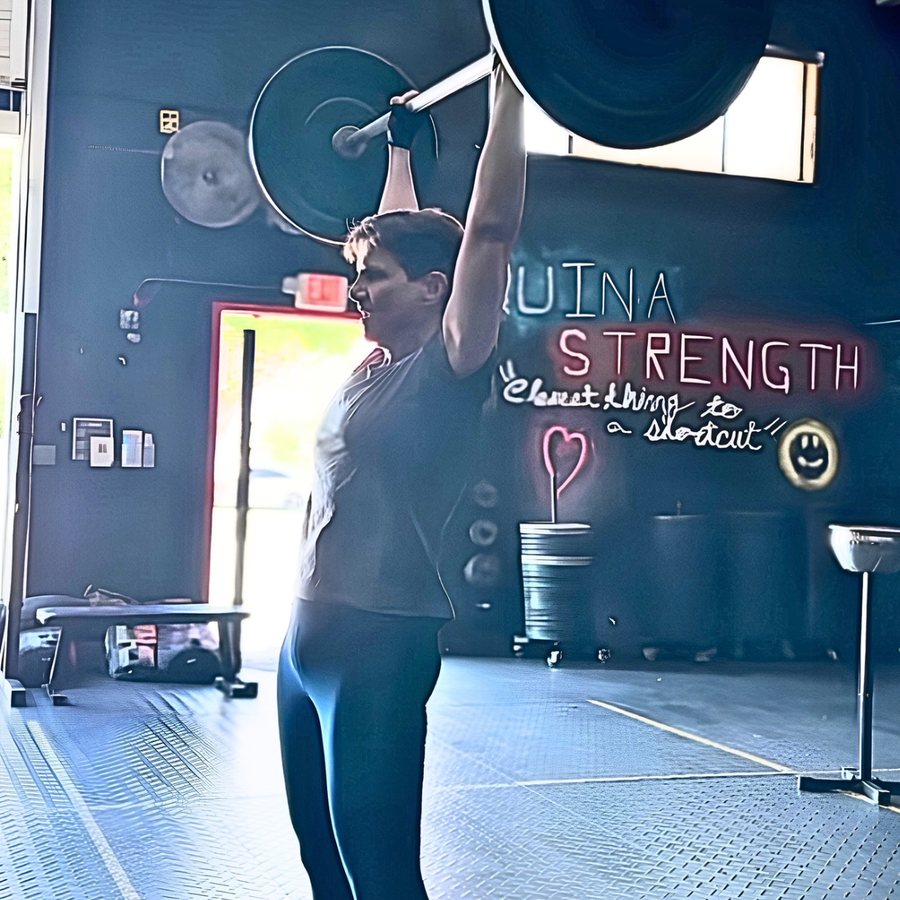
That's what programming actually means: a specific site is weak, so you choose the movement that loads it.
We also added push-ups and basic Olympic lifts for coordination and movement quality, built squats and deadlifts back up conservatively, and put one genuinely hard session in each week — because getting a little outside the comfort zone is the whole mechanism, and I've written elsewhere about how often older adults get stuck by never leaving it.
What her scans actually show
She's been on medical treatment for osteoporosis since just before she started training with me. That matters, and I'll come back to it — but first, here's the timeline her scans lay out.
Year one was treatment plus light, technique-focused training.
Year two was the same treatment plus heavy loading.
- Her spine didn't move at all in year one. In year two it improved substantially and is now close to the normal range.
- Her left femoral neck didn't move at all in year one. In year two it crossed out of the osteoporosis range entirely and into osteopenia.
- Her total femur didn't move at all in year one. In year two it improved.
- Her left radius — the forearm, her weakest site — improved in both years, and it's the one we targeted deliberately with pressing.
And this: no more knee sleeves. She doesn't need them.
Here's the part most people selling you something would leave out.
I can't tell you the training caused that, and I'm not going to pretend otherwise. She's been on medication the whole time, osteoporosis drugs often deliver more in the second year than the first, and the two years in question had roughly similar amounts of training in them — seven or eight months each.
Bone moves slowly. A few months of heavier lifting doesn't produce a jump that size on its own. The medication is doing most of this work, and anyone who knows the field would tell you the same.
So what am I actually claiming?
Something narrower, and I think more useful to you: she did the medical part and the loading part, and everything moved in the right direction. Most people in her position only ever do the first one — they take the prescription and keep their life exactly as it was.
And this, which isn't about bone at all: she arrived unable to squat without pain, in sleeves, with a body that wouldn't do what she asked it to. That part had nothing to do with any drug.
One more thing worth sitting with, because it's the part that's actually replicable.
Across those two years she trained about seventeen months in total, at three sessions a week. Not five, not six. Three, done properly, week after week.
She also lost two long stretches to things outside her control — a season out of state, then two months of being told not to lift. She came back both times and picked up where she'd left off.
That's the whole formula. Three days a week, heavy enough to matter, and a refusal to treat an interruption as an ending.
What she tells me, more or less constantly, is that she should never have stopped training.
And the thing the medication can't do at all
Here's what I tell people who come to me with a diagnosis, because the bone density conversation is only half of it.
Almost nobody with osteoporosis breaks a hip because their bone was weak while they were standing still. They break it because they fell.
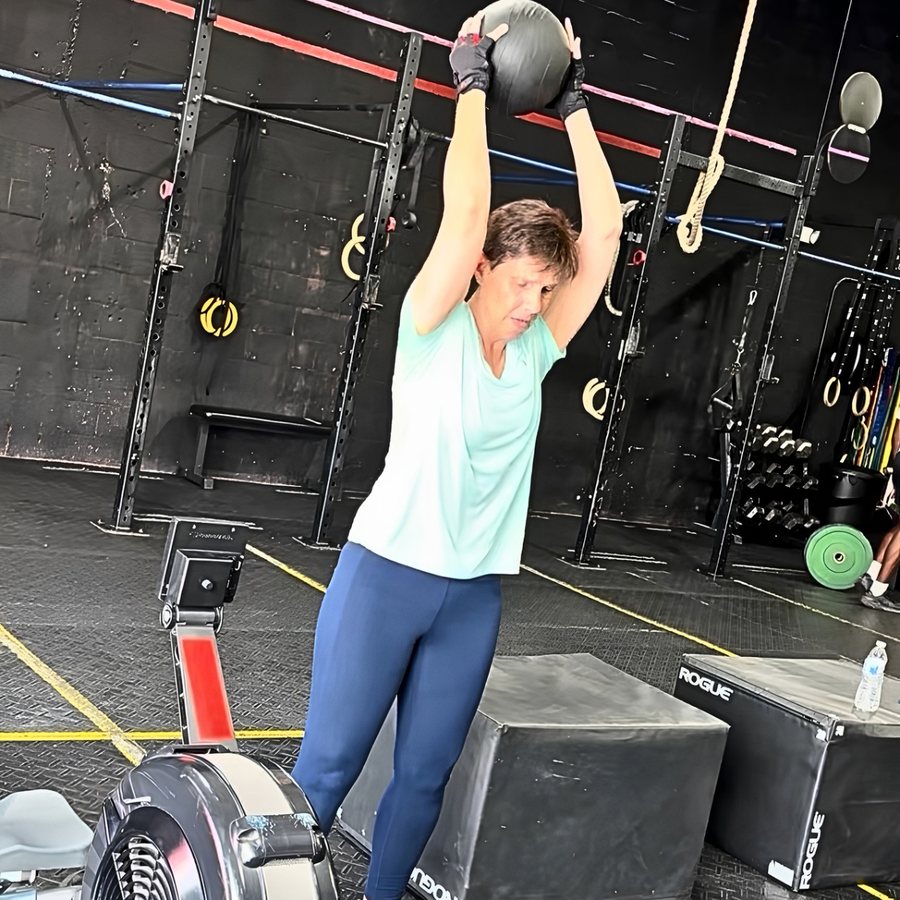
Medication improves the bone. It does nothing for any of the four things that stand between you and the floor:
- Not falling in the first place. Leg strength and balance are what keep a stumble from becoming a fall — and this is one of the better-established findings in the whole field.
- Reacting when you do. Breaking a fall is a neuromuscular skill: how fast you produce force, how quickly a hand or a foot gets where it needs to be. Training sharpens that. Nothing in a prescription does.
- Having something between the bone and the ground. Muscle over the hip absorbs impact. More of it means less force reaching the bone.
- Getting back up. How long someone lies on the floor after a fall matters enormously to how the whole episode goes.
So the honest hierarchy looks like this. For bone density, the medication is doing most of the work and training likely adds to it. For not breaking the bone in the first place, training is doing something no drug can.
Which is why the detail I keep coming back to from her two years isn't a T-score. It's that she arrived with poor balance, severe weakness around her knees, and sleeves on both of them — and she doesn't need the sleeves any more.
What this means if you're in your sixties
Not that your results will look like hers. Hers took two years, a diagnosis, medical treatment, and coming back after being told to stop.
What it means is narrower and more useful: the ceiling is much higher than you've been told.
She arrived unable to squat properly, in pain, in knee sleeves, with a bone density diagnosis. None of that turned out to be the end of the story. It was the starting position.
If you want the longer version of how this actually works — what changes after fifty and what doesn't — I've written it up as a full guide to strength training for women over 50. And the mechanism behind the bone density part is here.
If you have a diagnosis
Talk to your doctor before starting heavy barbell work. Not as a formality — the right answer genuinely depends on your numbers, and some movements are contraindicated for some conditions.
And if you're in that situation, what you want is supervised in-person coaching with your scan results in hand. Not a program you downloaded, and not an article.
If you're not managing a diagnosis
Then your situation is simpler than hers was, and the answer is the same one it always is. Get under a barbell. Get strong over a period of years. Write down what you lift so next week can be heavier.
Start before you have a reason to.
It's later. It isn't too late.
The same programming my members run in Palmetto Bay, built to work at any gym with a barbell and a rack.
See the program → First month free. $54/month after, billed $27 every 2 weeks.This article describes one member's experience and is general information about exercise and health. It isn't medical advice, and individual results vary considerably.