The advice people get after a scare is almost always the same word: careful. Be careful on the stairs. Be careful getting out of the car. It's well meant, and it isn't a plan — it's a request to concentrate harder, forever, with no end point and nothing that ever gets better.
There is a plan. It starts with noticing that a fall is two problems stacked on each other, and that nearly everything written about preventing falls only deals with the first one.
A fall is two problems
The first is not falling. Staying upright when the step is higher than you expected, when the floor is wet, when both hands are full and you're looking at something else.
The second is what the fall does to you once it's happening. Two people catch the same rug. One gets up irritated. The other fractures a hip, and the next year of their life is about that fracture. What separated those two outcomes was settled long before either of them hit the floor.
You can be good at the first problem and badly exposed on the second. Most advice on falls never mentions that the second one exists.
The first problem, briefly
I've written the long version of this one already, so I won't repeat it here: unsteadiness is usually a force problem rather than a sensing problem. The signal that you're tipping arrives fine. What's missing is a hip strong enough and quick enough to pull you back before gravity finishes the job. That's why standing on one foot at the bathroom sink does less than people hope, and why loading the legs does more.
If that's the part you came for, read strength training for balance and come back. The rest of this page is about everything that happens after the correction fails.
What the floor does to you
Here's the uncomfortable arithmetic. A fall from standing height delivers roughly the same force to everyone. What differs is the structure receiving it.
Most hip fractures in older adults happen in a fall, and the fall is usually unremarkable — a trip, a slip, a missed step. Not a dramatic event. The reason it breaks something is that the bone had been quietly thinning for twenty years and nobody was in a position to notice. Recovery is often incomplete. A meaningful number of people never get back the independence they had the week before it happened.
So the honest framing is this: training doesn't make you fall-proof. Nothing does. Everybody goes down eventually. What training changes is the price of it.
Bone responds to load the same way muscle does — it adapts to what you ask of it, and it gives back what you don't. Walking doesn't ask much; it's a load your skeleton has handled since you were two. Picking up something heavy asks a lot. That mechanism, and what to do about it, is in its own article here.
A dense femur and a thin one experience the same trip very differently. That is the single biggest lever on how a fall turns out, and it's invisible until the day it matters.
The skill almost nobody trains
Now the part that gets left out of every falls checklist I've ever read.
Being on the floor and unable to get up is its own event, separate from whatever the fall did to you. People lie there for hours. Not because they're badly hurt — often they aren't hurt much at all — but because getting from the floor to standing requires strength through a range they stopped using a decade ago, and in the moment it turns out not to be there.
The consequences of that are their own problem. Cold, dehydration, pressure on the skin, and a kind of fear that doesn't leave afterwards. Someone who falls and gets straight back up has had a bad moment. Someone who falls and waits three hours has had something that changes how they live.
And unlike most of what's on this page, it's a specific, trainable skill with specific parts: strength through a deep knee and hip bend, the ability to put weight over one leg, and enough shoulder and trunk strength to push yourself up off your hands.
A test worth doing once, carefully, with someone else in the room.
Get down to the floor and back up to standing. Then try it without using your hands. Then without pushing off a chair or a wall.
Whichever of those three you can't do yet is a thing to train, not a verdict on you. Most people over sixty who've been sedentary can't do the second one. Most of them can within a few months of real training.
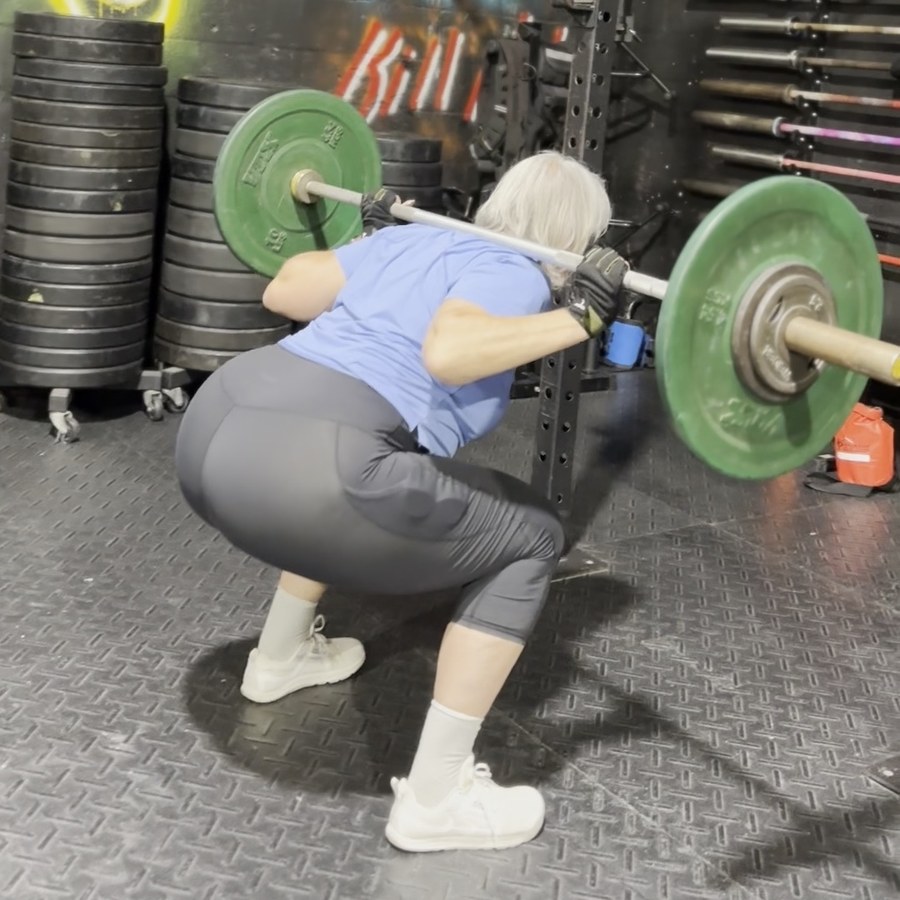
This is why I program squats through a real range rather than a comfortable half-dip, and why someone who can't yet reach that depth squats to a box instead of shortening the rep. The box keeps the position honest while the range comes back. Get out of a deep squat with a loaded bar on your back and standing up off a carpet stops being a question.
The spiral after a near miss
Something I see often enough to name it. Someone has a scare — doesn't even fall, just a bad wobble on a kerb — and their response is entirely sensible: they slow down, they stop doing the thing that frightened them, they hold the handrail, they skip the walk when it's raining.
Every one of those decisions is reasonable on its own. Together, over a year, they add up to doing less. Doing less makes you weaker. Being weaker makes the next wobble worse. The caution that was supposed to protect you ends up being the thing that raises the risk.
I'm not telling you to be reckless, and I'm not telling you the caution is wrong. Being careful on a wet step is just good sense, and most of the people I meet have been managing their own risk sensibly for years before they ever walk into my gym. The trap isn't caution. It's caution instead of getting stronger — treating care as the whole strategy when it's only ever the half of it that doesn't improve.
What training doesn't fix
I'd rather be straight about the limits, because a coach who tells you strength solves all of this is selling you something.
A good portion of fall risk has nothing to do with how strong you are:
- Medication. Blood pressure drugs, sedatives, sleep aids, some antidepressants — anything that makes you light-headed when you stand up. A strong person whose blood pressure drops on standing still goes down.
- Vision. An out-of-date prescription, cataracts, or bifocals on a staircase, where the bottom of the lens blurs exactly the step you're about to take.
- The inner ear. Genuine vestibular problems are real, they're diagnosable, and they're treatable — but not by me and not with a barbell.
- The house. Loose rugs, trailing cords, a dark stairway, the step down into the garage that you know is there until the one evening you don't.
- Alcohol. Unglamorous, and it shows up in this conversation more than people expect.
None of that is my lane. What I'd do with it: ask your doctor or your pharmacist to review everything you take, together, specifically for whether it affects your blood pressure or your alertness — pharmacists are very good at this and it's usually free. Get your eyes tested. Walk around your own house once looking only at the floor.
Do those three things and then train. The two halves aren't alternatives, and the people who do best at this are the ones who stop treating them as if they were.
Where to start
If you take three things from this page, take these.
- Get strong through a full range, not a comfortable one. Squats to depth, hinges, single-leg work, carries. The depth is the part that transfers to the floor.
- Load the skeleton, not just the muscles. That means weight that's genuinely heavy for you, progressed over months. It's the only part of this that changes what a fall costs.
- Book the medication review and the eye test. They cost you an afternoon and they cover the risks training can't reach.
And if you're reading this because of something that already happened — a fall, or a near one — the thing to resist is the instinct to do less. That instinct is the problem dressed as the solution.
If you want the whole picture rather than this one slice of it, strength training for women over 50 is where the argument starts.
Strong enough that a trip stays a trip.
The same programming my members run in Palmetto Bay — squats through a real range, hinges, single-leg work and carries, built to work at any gym with a barbell and a rack.
See the program → First month free. $54/month after, cancel anytime.This article is general information about exercise and health. It isn't medical advice and isn't a substitute for your doctor's assessment of your own situation.