It isn't the abs. The abs are nice.
It isn't being toned or jacked, though carrying muscle and staying lean beats the alternative in nearly every way that matters.
And it isn't being the strongest or the fastest. It's being strong enough and fast enough to live your life on your own terms.
Fit is what you can still do
Being fit is waking up most days feeling good. You might have aches. You might have a knee that tells you about the weather before the forecast does. But you're moving under your own power, and the question of a stick or a chair isn't on the table.
Most of us don't notice that's a thing we have until the day it starts going.
What the numbers actually buy
Every number in a gym is a stand-in for something outside it.
Can you squat your bodyweight? Then you can get all the way down to pick up your child or your grandchild, and stand back up with them in your arms.
Can you deadlift your bodyweight? Then bending over for the groceries is nothing. So is the bag of soil, the case of water, the box somebody left in the hallway.
Can you press half your bodyweight overhead? Then your suitcase goes into the overhead bin without you scanning the aisle for someone taller.
Can you cover 400 meters in three minutes? Then you can walk the neighborhood on Halloween with the kids and still be holding a conversation at the end of it.
Can you get down to the floor and back up ten times without stopping, breathing hard by the end? Then a slip in the bathroom is an indignity instead of an emergency.
That last one is the whole argument in miniature. Nobody falls fresh and rested. You go down with your heart already going, you push off your hands, and you get up — or you don't, and you wait. What happens during those minutes on the floor is its own subject, and it has remarkably little to do with how the fall looked.
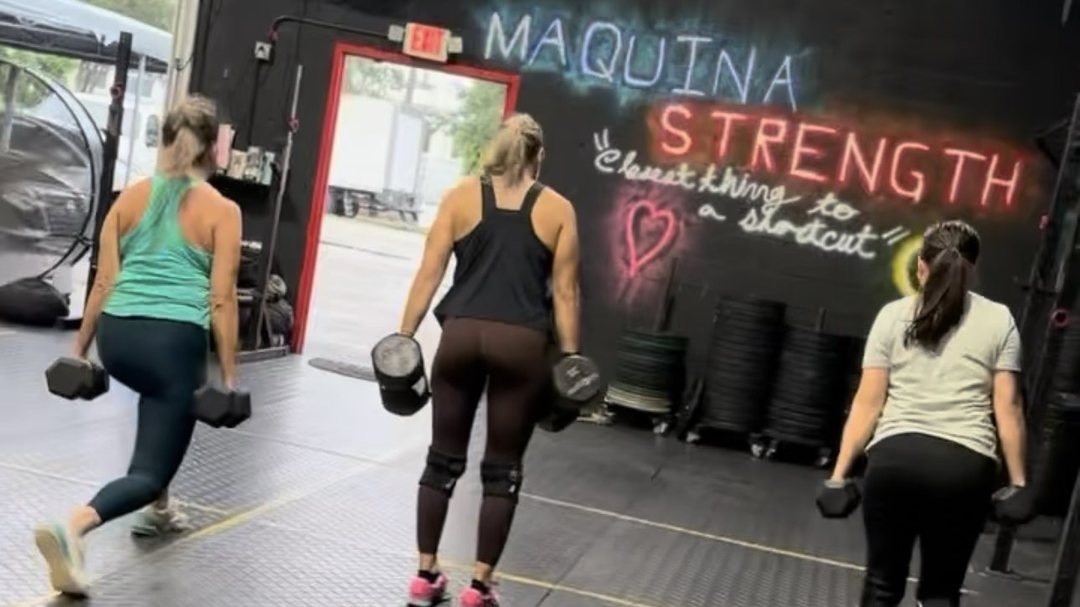
The point of training was never to be impressive in a gym. It's to build more capacity than your life asks for, so that the things your life asks for stop being hard.
The part nobody sees
An hour a day. That's the price.
In that hour you load your skeleton, which is the only signal that tells bone to stay dense. Bone density is what decides whether a fall is a bruise or a hip replacement, and walking doesn't ask enough of the skeleton to count.
You build muscle, which is where your body puts glucose. That's one of the reasons resistance training improves how people handle blood sugar.
And you keep the margin of strength that separates a stumble from a fall.
Carrying more muscle is consistently associated with living longer and living better. I'm not going to tell you the research proves which way the arrow points, because it doesn't. But nobody has ever found a version of aging well that runs through getting weaker.
About medication
Being fit doesn't mean never needing a doctor, and needing one doesn't mean you've failed at something. Plenty of strong, healthy people take something for a thyroid, a heart, an allergy, a condition they were born with.
But for a good deal of what gets prescribed in middle age — blood pressure, blood sugar, cholesterol — exercise isn't a nice-to-have sitting alongside the treatment. It is part of the treatment, and it says so in the guidance your doctor is working from. People who get meaningfully stronger over a year or two do sometimes find their doses come down. Some come off something entirely.
With their doctor. Never on their own, and never because they feel fine this month.
That's the only version of this I'll write, because the other version gets somebody hurt.
What training reliably changes is what your doctor is managing, and how much of it. That's worth a great deal. It just isn't the same promise as getting off your medication, and I'm not going to make that one.
Being there
Being fit isn't the aesthetics. Those arrive anyway if you stay consistent long enough — a byproduct, not the point.
It's being able to show up. For your family, for the people who count on you, and before either of those, for yourself.
And if you're starting from a long way back, that isn't a disqualification. It's just where the first session begins. This is what that actually looks like.
One hour a day, already written.
The same programming my members run in Palmetto Bay — squats through a real range, hinges, single-leg work and carries, built to work at any gym with a barbell and a rack.
See the program → First month free. $54/month after, cancel anytime.This article is general information about exercise and health. It isn't medical advice and isn't a substitute for your doctor's assessment of your own situation.